
Licensed Water Damage Contractor
Broussard, LA
Water damage restoration service
24/7 Emergency Response
The first thing most Broussard homeowners ask when water gets into their property is not how long it will take. It is whether the company they call can actually finish the job, or whether they are just hiring the first of three contractors they will eventually need.
Aivast Construction holds the Louisiana Mold Remediation license for extraction and remediation work and an active general contractor license for structural repair and rebuild. Both licenses. One company. Our office is at 2929 Hwy 90 E, which means when a job is running on the commercial corridor or in the neighborhoods around downtown Broussard, we are not coming from another parish. We are already here.
What South Louisiana's Climate Does to a Water-Damaged Structure in Broussard
Most water damage resources were written for places where humidity drops at night and building materials have a chance to release moisture on their own. Broussard does not work that way. From May through October, nighttime humidity in Acadiana stays high enough that framing cannot dry without mechanical intervention. Wet framing left to air out is framing that will grow mold.
The clay soils under most Broussard properties add a layer that most out-of-area contractors miss entirely. Clay expands when saturated and pulls back when it dries. That cycle is constant during a wet season. It puts lateral pressure on slab edges and foundation walls in ways that create pathways for moisture to move inward. A water intrusion that starts at the roof can show up as moisture along a slab edge on the opposite side of the building three days later.
This changes how an assessment gets done, how drying equipment gets positioned, and how long drying continues before the structure is ready for rebuild. A contractor who does not account for south Louisiana’s specific conditions will pull equipment too early, sign off on a structure that is not actually dry, and leave a mold problem that surfaces four to six weeks after the job closes.
Aivast has been doing restoration work in this climate long enough that we factor these realities into every scope from the first hour on site.
The Restoration Process on a Broussard Job
What Each Phase Actually Involves
The word restoration gets used loosely in this industry. Here is what the actual sequence looks like on a water damage job in Broussard, from initial call through final inspection.
Moisture Mapping Before Anything Else
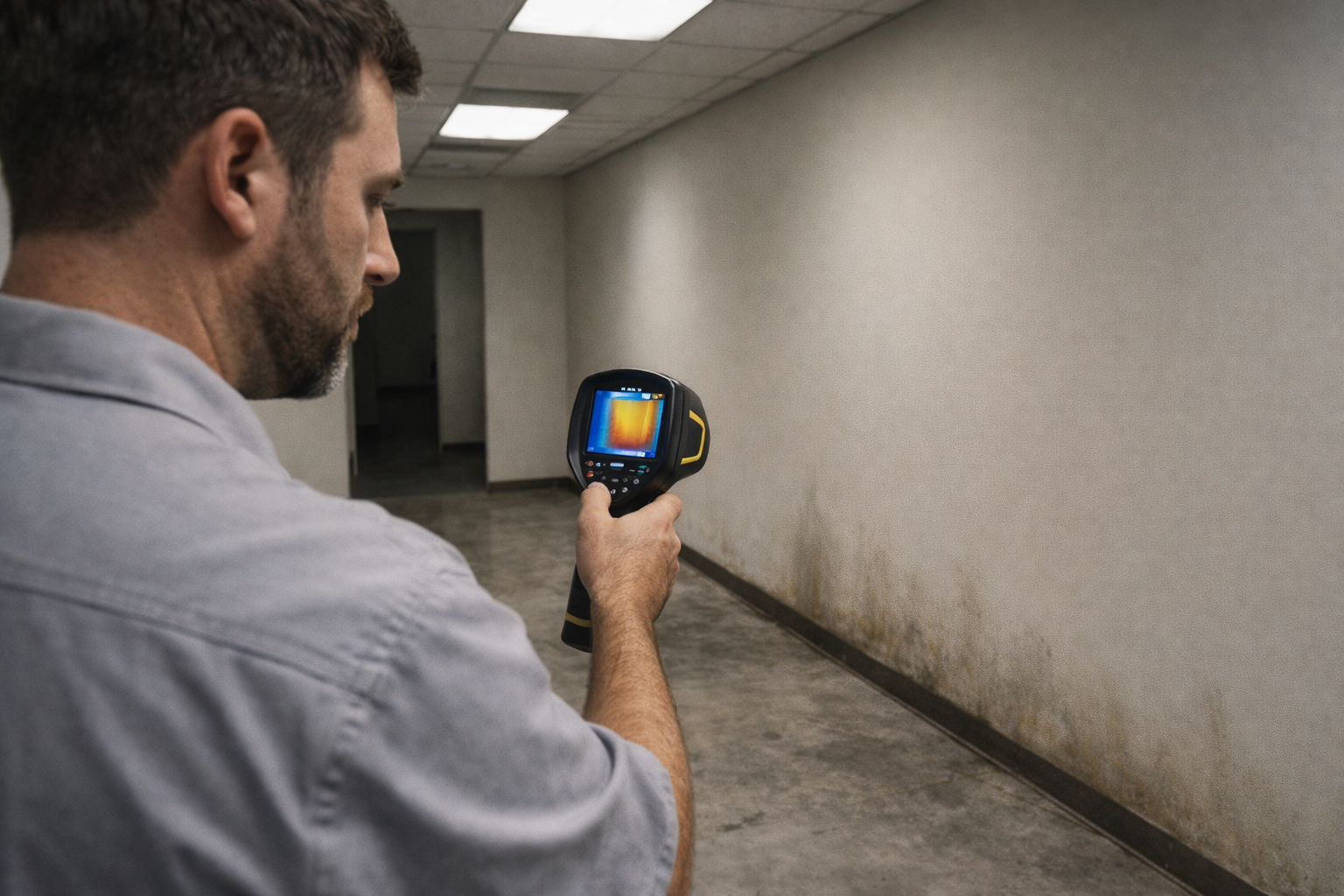
Before equipment goes in, we map the full extent of the moisture intrusion. Thermal imaging cameras and calibrated moisture meters locate water that has traveled beyond the visible damage. Water in Broussard structures almost always moves further than it looks. A roof intrusion surfaces in a wall cavity two rooms over. A slab leak shows up along a baseboard forty feet from the source. We establish the actual perimeter of the damage before setting a scope, because scopes that miss hidden moisture create callbacks.
Extraction and Structural Drying
Standing water extraction is the fastest part. Commercial truck-mounted extractors remove water from flooring and affected surfaces quickly. What takes longer is what comes after. Drying the structure itself.
Framing, concrete slabs, subfloor assemblies, and wall cavities hold moisture long after surface water is gone. Industrial dehumidifiers and positioned air movers run continuously until moisture readings return to baselines for south Louisiana’s ambient conditions. This takes days, not hours. In significant losses, it takes a week or more.
Mold Remediation When the Timeline Requires It
In Broussard’s climate, mold can begin colonizing wet materials within 24 to 48 hours of water intrusion. If a loss is caught fast and structural drying starts within that window, remediation may not be part of the scope. If time has passed, it almost certainly is.
Remediation under Louisiana’s Mold Remediation license involves containment of affected areas, HEPA air filtration, physical removal of colonized materials, surface treatment, and post-remediation clearance testing. Each step is documented.
Structural Repair and Rebuild Under One GC License
Once the structure passes clearance, rebuild starts. Damaged framing, drywall, insulation, flooring, and exterior materials get replaced. If the scope includes structural repairs, foundation work, or electrical repairs caused by water damage, permits go through the City of Broussard’s permit office. We handle submissions and inspection coordination. The rebuild does not start with a new contractor who has never seen the damage assessment. It continues with the same company that did the drying.
How the Hwy 90 Corridor and Downtown Broussard
Drain and Where That Fails
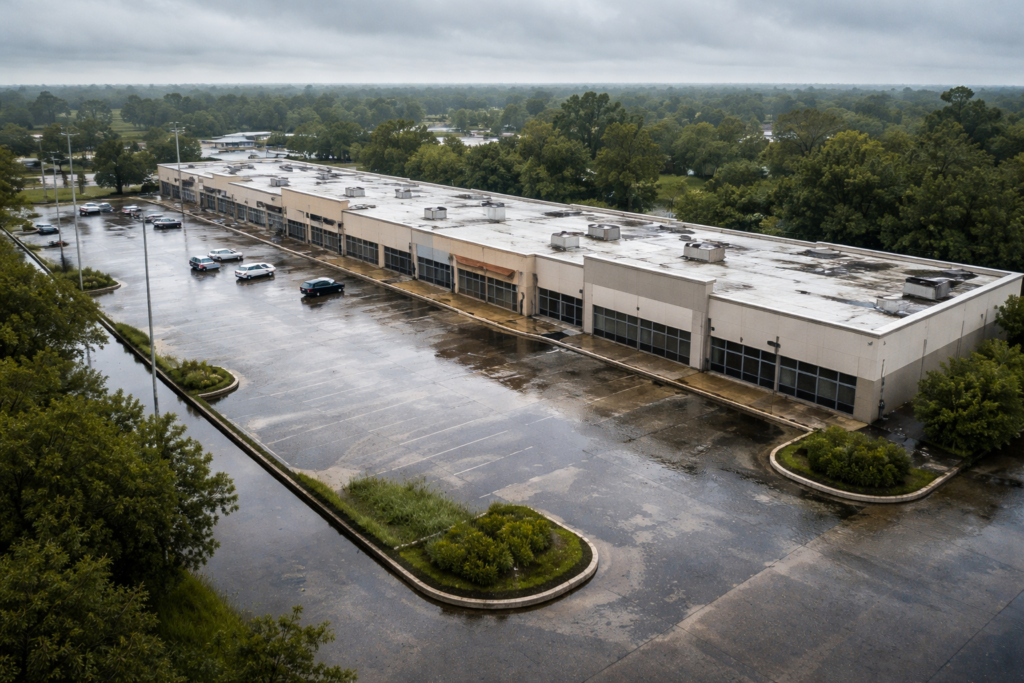
The Hwy 90 commercial corridor through Broussard handles a concentrated volume of impervious surface runoff. Parking lots, rooftops, and paved commercial areas shed water fast. During intense rain events that volume reaches drainage infrastructure faster than residential neighborhoods do. When the system hits capacity, water backs up toward commercial foundations and adjacent properties before it can move to outfall points along Bayou Tortue and the surrounding drainage network.
Properties along Roto Park Drive and the commercial stretch between the eastern and western city limits see this on a regular basis during tropical weather. The drainage improvements Broussard implemented after 2016 helped the overall system. They did not eliminate the problem at the property level, particularly for structures with low slab elevations or drainage grading installed before current standards.
Downtown Broussard and the Billeaud District carry a different profile. Older commercial buildings in this corridor were built before modern drainage design standards. Many sit closer to grade than newer construction. Water intrusion through slab edges, aging foundation walls, and deteriorated waterproofing is a different category of problem than storm water coming through a roof. Assessing this part of Broussard correctly requires someone who knows both profiles and has worked in both.
What Hurricane Season Leaves Behind in
Broussard Structures Months Later
The visible damage from a tropical system is not always the expensive damage. Wind-torn shingles and blown-out windows get repaired quickly because they are obvious. What does not get repaired quickly is the moisture that entered through a compromised soffit vent, worked into the attic insulation, and sat there through weeks of post-storm heat.
Broussard is far enough inland that wind speeds arriving from the Gulf are reduced. But tropical rain is not a Gulf Coast problem. It moves with the system. Properties that took minimal direct wind damage from Laura and Delta still experienced moisture intrusion through wind-driven rain at joints, penetrations, and around ridge systems. That moisture, sitting in attic spaces and wall cavities without air conditioning running during a prolonged outage, is where post-hurricane mold starts.
The restoration calls we receive months after a storm event are often from homeowners who completed cosmetic repairs without addressing the moisture left behind. Drywall was patched. Paint went on. The smell started six weeks later.
At that point the scope is larger than it would have been. Getting to a Broussard structure early after a hurricane, even when visible damage seems minor, is the single best way to keep restoration cost in proportion to the actual damage.
The Louisiana Mold Remediation License
Why It Matters for Your Specific Job
Louisiana is one of the few states with a mandatory license specifically for mold remediation. The Louisiana State Licensing Board for Contractors issues the Mold Remediation Contractor license separately from a general contractor license. Holding a GC license does not authorize a company to perform mold remediation in Louisiana, regardless of how the work is described in a contract.
What the license actually requires: passing state examination on mold science, remediation protocols, containment procedures, and post-remediation verification. The licensee must also carry insurance coverage for remediation work. This is not a registration. It is a technical examination with ongoing compliance requirements.
Aivast holds this license. On a practical level, that means remediation work on your Broussard property is performed under licensed authority, documented to state standards, and verified by post-remediation clearance testing. It also means the same company that remediates can legally complete the rebuild, which eliminates the most common failure point in water damage restoration: the gap between the restoration company and the general contractor.
Before any contractor begins mold remediation work on your property, ask for the license number and verify it at the Louisiana State Licensing Board for Contractors website. Two minutes. Protects you from work performed outside legal authority.
Why Structural Drying in Broussard
Takes Longer Than Published Timelines Suggest
National restoration literature puts structural drying at three to five days. That number was not written for south Louisiana. In Broussard’s ambient humidity, three to five days is a floor, not an average. Structures with moisture migration into concrete, subfloor assemblies, or multiple wall cavities regularly need seven to ten days of continuous equipment operation before readings reach levels that meet the threshold for rebuild.
Drying equipment works by reducing vapor pressure inside the structure below the vapor pressure inside wet materials. That pressure difference causes moisture to move from the material into the air, where dehumidifiers capture it. When outside humidity is already high, maintaining that differential requires more equipment capacity and more time than drying in a dry climate.
Concrete slabs are the slowest-drying material in a typical Broussard structure. A slab that was under standing water for 24 hours may need twice the drying time of the framing above it. Pulling equipment when framing reads dry but before the slab reaches an acceptable moisture level is a common error that causes flooring failures after installation.
We track moisture readings at multiple points throughout the drying process and document them daily. Equipment comes out when the numbers say it is time, not when the calendar does.
Pulling Permits Through the City of Broussard After Water Damage
Broussard operates its own building permit office independently from Lafayette City-Parish. That is not a small administrative difference. Permit submissions, plan review, and inspection scheduling for properties within Broussard’s city limits go through City of Broussard offices, not through Lafayette’s Consolidated Government permit department.
Water damage restoration that involves structural repairs typically triggers a permit. Framing replacement, foundation repair, electrical work caused by water damage, and work affecting structural elements all require a permit through the City of Broussard. Cosmetic repairs, painting, cabinet replacement, and floor covering generally do not.
Commercial properties on the Hwy 90 corridor add a second layer. Commercial projects in Broussard route through both the City of Broussard permit office and the Louisiana State Fire Marshal’s office for plan review. Aivast knows what each office requires before they ask for it. Submissions that come in complete move through faster than submissions that get sent back. That difference is measured in weeks on a restoration timeline, not days.
The Broussard Hwy 90 Corridor: Aivast's Home Service Area
Aivast Construction is based at 2929 Hwy 90 E. The Hwy 90 corridor is not a service area we drive to. It is where we work every day. Our crews know the commercial corridor from the western approach at the Youngsville city limits through the downtown core past Arceneaux Park and Roto Park Drive, and east toward St. Martin Parish.
Within Broussard’s city limits, we handle water damage calls throughout the Billeaud District, the East Main Street corridor, properties along St. Nazaire Road and South Bernard Road, and residential neighborhoods throughout the city. For Broussard’s northern, southern, eastern, and western zones, we maintain separate location pages with neighborhood-specific information for each area.
Not sure which zone your address falls in? Call 337-345-1078. Straight answer in two minutes.
Why Restoration Jobs Break Down at the Handoff, and How Aivast Is Structured Differently
Water damage restoration breaks down at a predictable point: when the restoration company finishes drying and remediating and hands the job to a general contractor who has never been on the property. The GC finds damage that the restoration company did not document. The scope changes. The insurance adjuster is not on board with the change. The homeowner ends up in the middle of a dispute between two companies, neither of whom has a reason to take responsibility for the gap.
Aivast does not have a handoff. The company that does the moisture mapping, runs the drying equipment, and holds the Mold Remediation license for the remediation phase also holds the general contractor license for the rebuild. There is no documentation gap between restoration and construction because there are not two separate companies creating two separate records.
That structure matters most on complex jobs: commercial properties, older structures with pre-existing conditions, post-hurricane rebuilds where the full scope only reveals itself as work progresses. On those jobs, one accountable contractor throughout is not a convenience. It is the difference between a job that closes cleanly and one that drags for months.
Most water damage in Broussard gets worse the longer someone waits on the call. The contractor who shows up first, maps the full moisture footprint, and stays through final inspection is the one who gives you a number that holds.
Q and A: Water Damage Contractor in Broussard
Q: Does Louisiana require a specific license for mold remediation work?A: Yes. The Louisiana State Licensing Board for Contractors issues a separate Mold Remediation Contractor license required for any mold testing, remediation, or post-remediation verification work, regardless of project cost. A general contractor license alone does not cover mold remediation. Aivast holds both the Mold Remediation license and a general contractor license, covering the full restoration and rebuild scope under one company. |
Q: Why does structural drying take longer in Broussard than national averages suggest?A: Broussard’s ambient humidity during most of the year is too high for building materials to release moisture on their own. Mechanical dehumidification is required to lower vapor pressure inside the structure enough for framing, concrete, and wall assemblies to dry to levels that allow rebuild. South Louisiana structural drying commonly runs seven to ten days or more on significant losses, not the three to five days in national restoration guidelines. |
Q: Do water damage repairs in Broussard require a building permit?A: Structural repairs following water damage, including framing replacement, foundation repair, and electrical work caused by water damage, typically require a permit through the City of Broussard’s permit office, which operates independently from Lafayette City-Parish. Commercial properties on the Hwy 90 corridor also route through the Louisiana State Fire Marshal for plan review. Aivast handles all permit submissions as part of the restoration and rebuild scope. |
Q: What makes the Hwy 90 corridor drainage different from residential Broussard?A: The Hwy 90 commercial corridor concentrates high-volume impervious surface runoff from parking lots, commercial rooftops, and paved areas. During intense rain events, that volume reaches drainage infrastructure faster than residential areas do. When the system hits capacity, water backs up toward commercial foundations and adjacent properties before it can reach outfall points. Properties with lower slab elevations or pre-2016 drainage grading are most exposed to this pattern. |
Q: What should I do immediately after water gets into my Broussard home or business?A: Call 337-345-1078. While you wait, stop the source if it is still active — shut off the water supply or cover any roof penetration with a tarp if it is safe to do so. Move items of value away from the water but do not use a shop vac or household fans as primary drying tools. They are not sufficient for structural drying in south Louisiana’s humidity and can spread contaminated water. Document everything with photos before anything is moved. |
When Every Minute Counts,
Count on Us
We know that downtime equals lost revenue and disrupted operations. That’s why we prioritize fast mobilization, clear communication, and high-quality execution, so you can get back to business with confidence.