

Water Damage Restoration Service in North Broussard
24/7 Emergency Response
Water damage restoration service
Many homeowners in Le Triomphe, Cypress Meadows, and Sugar Trace call us after a water loss, expecting a quick job. Newer home. It should dry fast. The opposite is usually true.
Aivast Construction handles water damage restoration throughout North Broussard. We hold the Louisiana Mold Remediation license and an active general contractor license, which means that assessment, drying, remediation, and rebuilding are handled by a single company. Call 337-345-1078 to schedule a site assessment.
Newer Construction Does Not Mean Dry Construction
What North Broussard Homes Are Showing Us
Homes built in the last ten years in Cypress Meadows or Le Triomphe are not going to perform better under water intrusion than an older structure. In some ways they perform worse. Modern construction creates vulnerabilities that older builds simply do not have.
Newer homes in north Broussard are built tighter than construction from twenty or thirty years ago. Better air sealing, higher-density insulation, engineered lumber systems. All of it improves energy performance. It also changes how water behaves inside a wall assembly once it gets in.
In an older, leaker structure, moisture has escape paths. Air moving through gaps and imperfect seals carries some moisture out. In a tight modern envelope, water that enters a wall cavity stays there. The building holds it in.
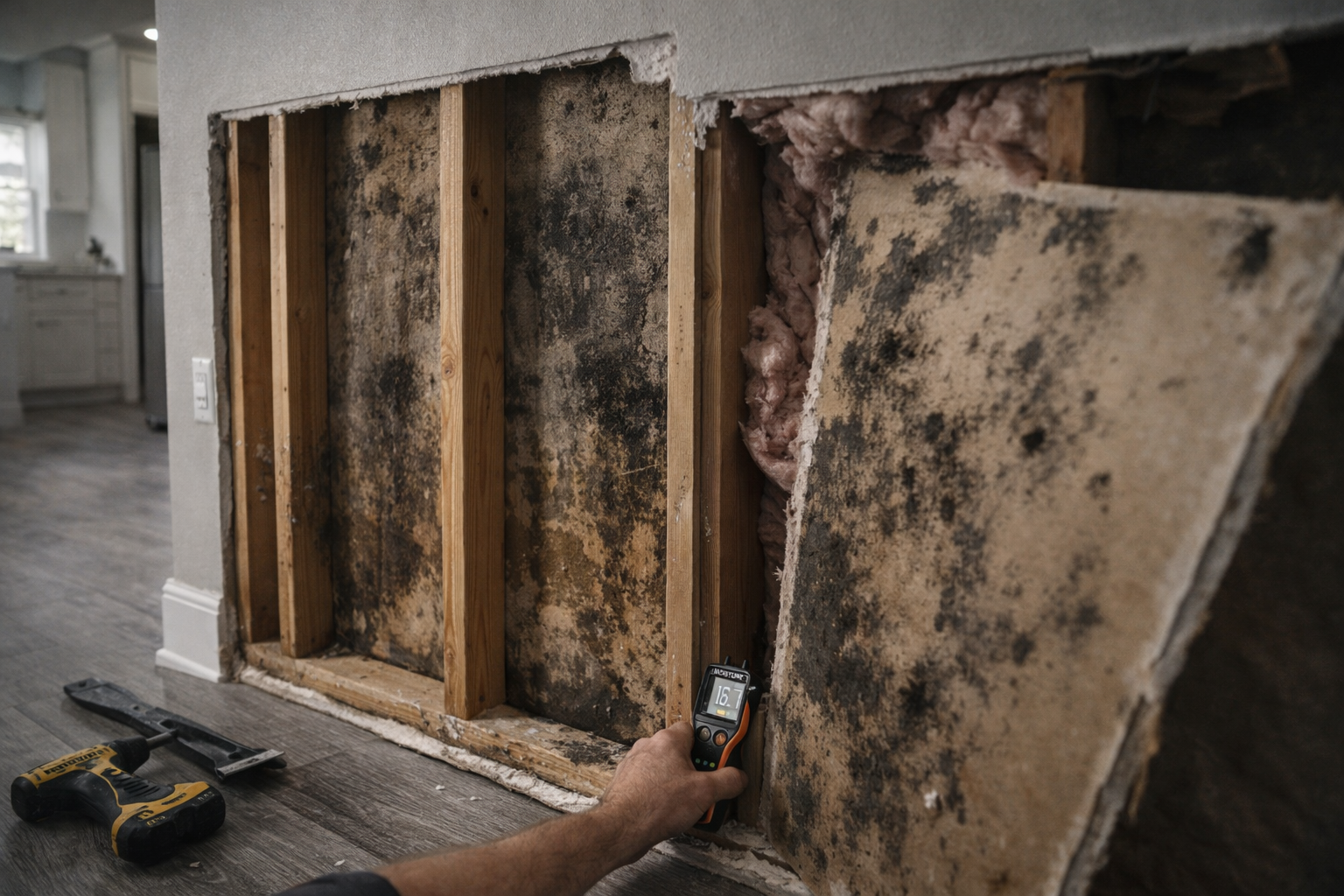
This shows up on restoration jobs as mold colonies behind finishes in homes that show no visible problem from the living space side. A slow drip behind a shower surround in a Sugar Trace home. A flashing gap at a rough window opening in a Vintage Park house. A dishwasher supply line fitting that was never quite right. Each of these can saturate wall assemblies and produce heavy mold growth before a homeowner sees or smells anything.
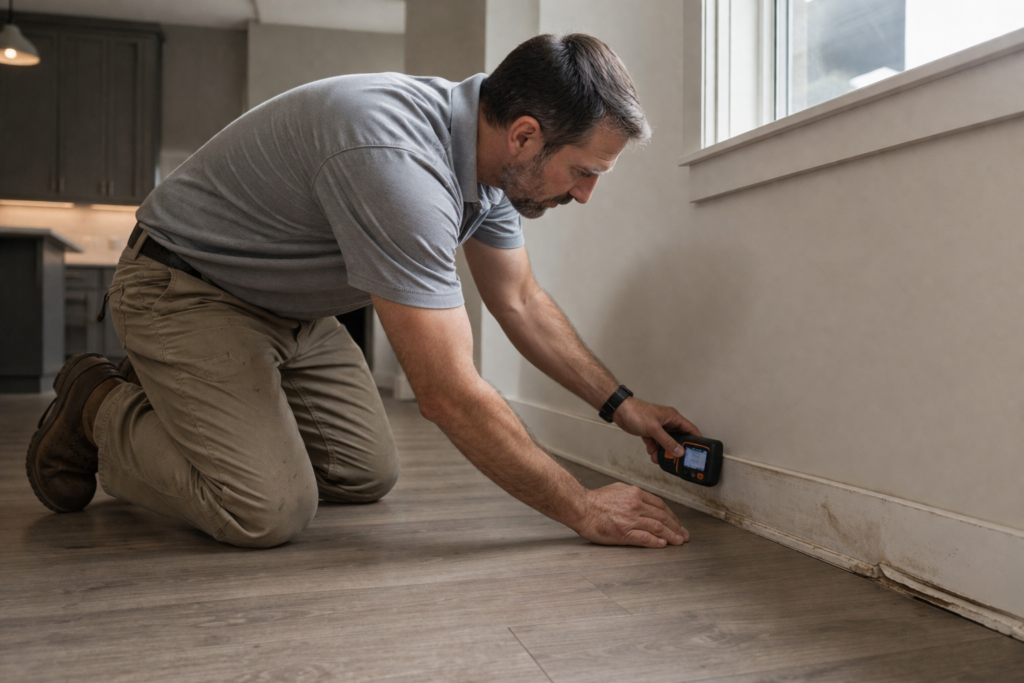
Visible inspection alone is not enough for a north Broussard water damage assessment. Thermal imaging and moisture meters have to go behind surfaces that look fine. The damage in newer construction is often invisible until someone looks for it.
Slab-On-Grade Moisture in North Broussard's Growing Neighborhoods
The dominant foundation type in north Broussard’s newer neighborhoods is slab-on-grade. Poured concrete slabs are cost-effective and durable. They also carry a moisture characteristic that affects every water damage job in these neighborhoods. Concrete is a slow dryer.
When a slab-on-grade home in Le Triomphe or The Reserve Estates takes on water from an appliance failure, a plumbing supply line, or a roof intrusion that migrates into the floor plane, the concrete slab absorbs it and retains it. Framing and drywall above the slab may test dry within a week of proper drying. The slab itself may retain measurable moisture for 2 to 3 weeks longer, depending on the volume of water and the thickness of the pour.
Flooring installed before the slab reaches an acceptable moisture level will fail. Hardwood buckles. LVP planks cup. Tile adhesive loses bond.
These failures show up three to six months after a restoration job that was signed off as complete. The cause is always the same: slab moisture was not verified before the floor covering went down. Aivast monitors slab moisture readings separately from structural drying readings throughout every job in slab-on-grade homes. The floor covering conversation does not start until both sets of readings are in place.
How Tight Building Envelopes Trap Moisture in
Le Triomphe and Cypress Meadows
Modern building science has produced homes that perform far better in terms of energy efficiency than those constructed a generation ago. The tradeoff is that moisture management inside these homes requires more care after water loss. In South Louisiana’s climate, that tradeoff shows up clearly on every restoration job.
A tight building envelope in a Le Triomphe or Cypress Meadows home means that once humidity gets into a wall assembly, a ceiling cavity, or a conditioned crawl space, it stays there. The vapor retarder systems that keep exterior humidity out also keep interior moisture when water intrusion reverses the expected pressure gradient.
Spray foam insulation, common in newer Broussard construction, adds another layer to restoration work. Closed-cell spray foam does not absorb water as fiberglass batt insulation does, but it makes moisture mapping harder because it can block thermal imaging signatures. Open-cell spray foam readily absorbs water and retains it against framing for extended periods. Neither type dries the same way as conventional insulation.
Restoration protocols must account for which system is in the wall. An assessment designed for stick-frame construction with fiberglass batts does not directly transfer to a spray foam or structural insulated panel home. We assess for the specific system in each house, not for a generic residential profile.
Mold Behind Finishes:
What Renovation Work in Sugar Trace and Monjardin Keeps Uncovering
One of the clearest windows into water damage history in North Broussard is renovation work. When homeowners open walls for kitchen or bathroom updates in Sugar Trace, Monjardin, or Vintage Park, they regularly find moisture damage that predates the current renovation. Mold in wall cavities. Stained framing. Deteriorated sheathing. None of it was visible from the surface.
This is not unusual. It is the predictable result of water losses that were addressed incompletely: surface repairs without structural drying, or drying that ended too early in South Louisiana’s humidity. The mold colony was contained behind the finish material. It did not go away. It kept growing at whatever pace the ambient moisture inside the wall assembly supported.
When renovation work exposes this kind of pre-existing mold, the renovation stops. Adding new materials over an active mold colony and sealing it behind fresh drywall is not remediation. It is concealment. And it will produce the same result again within a few years.
Aivast regularly handles mid-renovation mold discoveries in North Broussard. The process involves assessing the full extent of the pre-existing condition, remediating under our Louisiana Mold Remediation license, verifying clearance, and then completing the renovation scope as planned.
Storm Water Intrusion Patterns in the Ambassador Commons
and St. Nazaire Road Corridor
The Ambassador Commons and St. Nazaire Road corridor in northern Broussard has seen steady residential and commercial growth over the past decade. That growth changed how stormwater moves through this part of the city. As impervious surface area increased, the volume of runoff reaching drainage infrastructure during intense rain events increased.
Newer homes in Ambassador Commons were built to current Broussard drainage standards, which handle this runoff volume better than older construction did. The vulnerability in this corridor is at the property level: grading that settled after original construction, downspout systems that discharge too close to foundations, and window and door threshold details that were not designed for wind-driven rain at tropical storm intensity.
Storm intrusion in this corridor most commonly shows up in the first six to twelve inches above the slab. Water enters through thresholds and window sills during driven rain events, not through roofline failures. The damage pattern is horizontal rather than vertical.
That matters for assessment. Horizontal intrusion shows up in wall bases, lower cabinets, and flooring rather than in ceiling staining. This profile is easy to miss during a visual inspection if the assessor is primarily looking upward for the source. Properties along St. Nazaire Road in the northern approach to Le Triomphe exhibit a similar pattern, where drainage from adjacent open land concentrates water along the roadside during extended rain events.
Structural Drying for Engineered Lumber Systems
in North Broussard Homes
Engineered lumber, LVL beams, I-joists, and laminated strand lumber are standard framing in the newer homes that make up most of North Broussard’s residential neighborhoods. These products are built to perform well. Underwater intrusion needs attention that dimensional lumber does not.
I-joists, common as floor framing in multi-story homes in Le Triomphe and Cypress Meadows, are manufactured with oriented strand board webs. OSB absorbs water and can delaminate when saturated. A wet I-joist web does not recover to full structural performance after drying the way a dimensional lumber joist does.
The assessment question for a wet I-joist system is not just whether it is dry. It is whether the structural integrity has been compromised. That evaluation belongs in every restoration assessment for newer homes in North Broussard.
LVL beams and headers carry related considerations. Extended water exposure at end cuts and connections can affect performance over time. Drying protocols for engineered lumber systems require different equipment positioning and longer monitoring periods than those for dimensional lumber under the same conditions. We account for these differences when setting up drying equipment in North Broussard.
What a Water Damage Assessment Looks Like in
a North Broussard Home
Homeowners in Le Triomphe, Sugar Trace, and the surrounding neighborhoods often ask what to expect when an Aivast crew shows up for a water damage assessment. The process is direct and does not require the homeowner to have figured anything out before we arrive.
The Walk-Through Starts Before Equipment Comes Out
The first conversation is about what happened. When did the water appear? What was the source, if known? What has been done since? That timeline matters more than most homeowners expect. A loss that is two days old is a different scope than one that is two weeks old in South Louisiana’s humidity. We want to understand what we are walking into before the assessment begins.
Thermal Imaging and Moisture Mapping
Thermal cameras show temperature differentials that indicate moisture behind surfaces. Moisture meters verify what the cameras suggest. In a north Broussard water loss, we map readings at multiple points throughout the affected area and in adjacent spaces. Water in these homes migrates further than the visible damage suggests. Wall cavities, ceiling planes, and the slab below are all checked.
Written Scope Before Any Work Starts
At the end of the assessment, you get a written scope describing what was found, what the recommended course of action is, and what the work will involve. Nothing starts with a verbal agreement. You know what is happening, what it covers, and what the process looks like before anyone picks up a piece of equipment.
Serving Le Triomphe, Cypress Meadows, Vintage Park, Monjardin, and The Reserve Estates
Aivast Construction handles water damage restoration calls throughout north Broussard’s residential neighborhoods. Le Triomphe and its golf course community. The established family neighborhoods of Cypress Meadows. The newer construction in Vintage Park and The Reserve Estates. The growing Ambassador Commons corridor along St. Nazaire Road. The residential streets of Monjardin. All of these fall within our regular service area.
These neighborhoods share newer construction profiles, slab-on-grade foundations, and tight building envelopes. That combination defines water damage restoration work in North Broussard. Our assessments and restoration protocols are built around these specific construction systems, not adapted from a generic residential template.
For water damage restoration in Broussard’s southern and eastern neighborhoods near Bayou Tortue Road, or in the western corridor towards Youngsville, see our related location pages for those areas. For properties on the Hwy 90 commercial corridor and downtown Broussard, see our Broussard Core page.
North Broussard’s newer neighborhoods look clean. The damage is usually behind the walls. Call before it gets bigger.
Q and A: Water Damage Restoration North Broussard
Q: Why do newer homes in North Broussard still develop mold after water damage?A: Modern construction in Le Triomphe, Cypress Meadows, and similar north Broussard neighborhoods uses tighter building envelopes and higher-density insulation than older builds. These systems hold moisture more effectively once water intrudes. A slow leak behind a tub surround or under a slab can saturate wall assemblies and cause heavy mold growth before any surface signs appear. Tight construction traps moisture once it enters. It does not prevent mold from developing. |
Q: Are slab-on-grade homes more vulnerable to prolonged moisture after a water loss?A: Concrete slabs absorb water and release it much more slowly than wood framing. In a slab-on-grade home in Le Triomphe or The Reserve Estates, framing and drywall may test dry within a week, while the slab continues to hold measurable moisture for two to three additional weeks. Flooring installed over a slab that has not fully dried will fail within months. Aivast monitors slab moisture readings separately from structural readings before any floor covering is installed. |
Q: Does stormwater intrusion look different in newer north Broussard construction?A: Yes. In newer construction in Ambassador Commons and The Reserve Estates, storm intrusion most commonly enters through flashing details, window rough openings, and door thresholds rather than through roofline failures. The damage pattern is horizontal rather than vertical, appearing in wall bases and lower cabinets rather than ceiling staining. This profile is easy to miss on a visual inspection if the assessor focuses primarily on the roofline as the source. |
Q: What should I do if mold is discovered during a renovation in my north Broussard home?A: Stop the renovation and get a moisture assessment before any additional demolition or new construction proceeds. Opening walls during renovation frequently reveals pre-existing mold that predates the current project. Installing new materials over an active mold condition will produce the same damage again within a few years. Aivast assesses the full extent of pre-existing conditions, remediates under our Louisiana Mold Remediation license, verifies clearance, and then coordinates with your renovation scope. |
Q: How do engineered lumber systems affect water damage restoration in newer Broussard homes?A: Engineered lumber products like I-joists and LVL beams are common in north Broussard homes built in the last fifteen years. These products respond differently to water than dimensional lumber. I-joist webs use oriented strand board, which can delaminate when saturated and may not recover to full structural performance after drying. Restoration assessments in newer north Broussard homes should include a structural evaluation of any engineered lumber that was wet. |
When Every Minute Counts,
Count on Us
We know that downtime equals lost revenue and disrupted operations. That’s why we prioritize fast mobilization, clear communication, and high-quality execution, so you can get back to business with confidence.