
Water Damage Restoration in West Broussard
Water damage restoration service West Broussard
24/7 Emergency Response
The west side of Broussard is the city’s fastest-growing area. Village at Broussard, Cypress Crossing, and the neighborhoods developing along the Ambassador Caffery extension represent some of the newest residential construction in all of Acadiana. New construction means no water damage problems. It means different types of water damage, and in some cases, problems that are harder to identify because they show up inside walls that look brand new from the outside.
Aivast Construction handles water damage restoration in West Broussard’s growing residential corridor. We are based at 2929 Hwy 90 E, which puts us minutes from Village at Broussard and Cypress Crossing. We hold the Louisiana Mold Remediation license for the restoration phase and a general contractor license for the rebuild. Call 337-345-1078 to schedule a site visit.
Fast-Growing Corridor, Fast-Moving Water:
How Development Changes Drainage in West Broussard
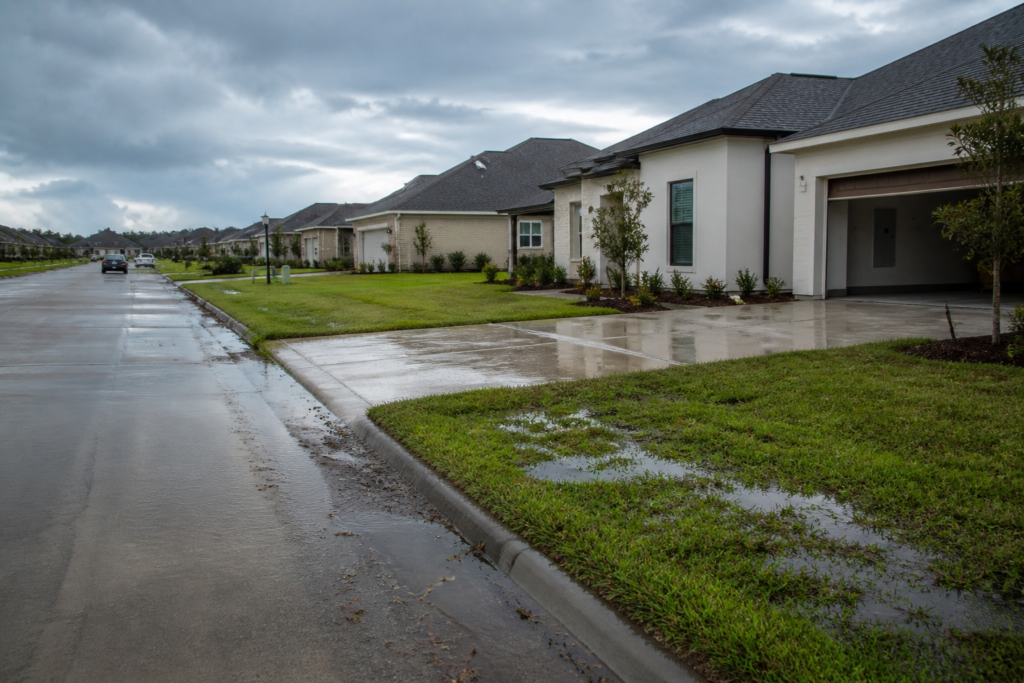
The Ambassador Caffery corridor through west Broussard has transformed from a largely undeveloped stretch into one of the most active residential and commercial development zones in Lafayette Parish over the past decade. That transformation has consequences for drainage that individual homeowners in the newer neighborhoods do not always anticipate when they purchase a new home.
As each new subdivision, commercial pad, and paved area goes in along the corridor, the total impervious surface area increases. More impervious surfaces mean more stormwater runoff reaches the drainage network more quickly during rain events. Drainage systems designed and permitted based on watershed conditions at the time of construction may now handle a significantly larger runoff volume than they were originally sized for.
For homeowners in Village at Broussard and Cypress Crossing, this shows up as drainage that functions well during normal rain events but becomes stressed during intense tropical rainfall. A subdivision whose drainage was engineered when it was the western edge of Broussard’s developed area may now sit in the middle of a developed corridor that contributes significant additional runoff to the same downstream drainage paths.
Individual property grading is the most controllable variable in this equation. A home whose yard drains away from the foundation during normal rainfall may pool against the foundation during events where upstream volume overwhelms the street drainage system. Recognizing this dynamic is the first step in understanding why some West Broussard homes that have never had a water problem suddenly develop one after a significant rain event.
Construction Defect Moisture in New West Broussard Homes:
What Shows Up in Years Two and Three
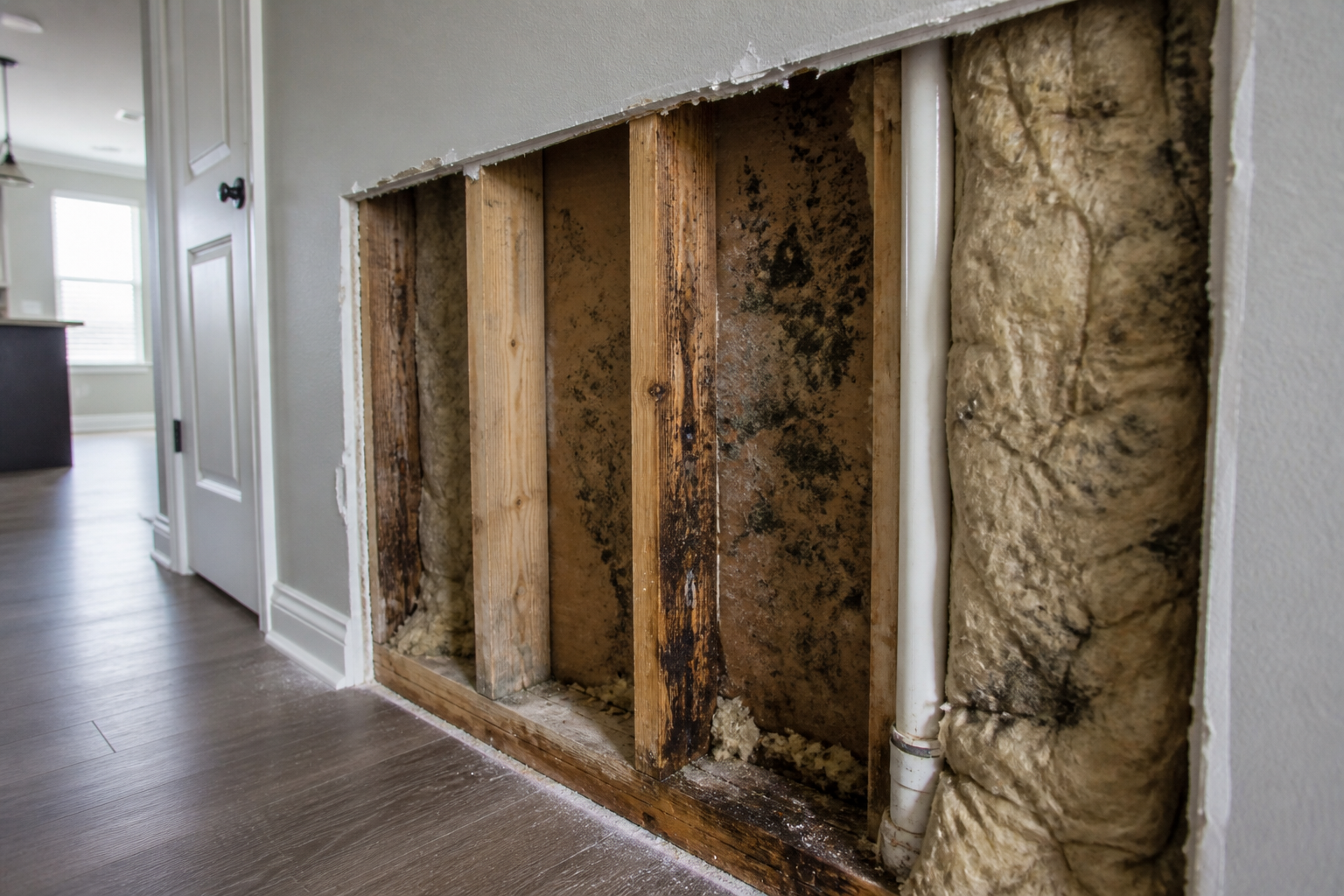
The most common water-damage pattern in West Broussard’s newer construction is not caused by storms or plumbing failures. It stems from construction defects that allow gradual water intrusion during normal rain events, flashing details that were not executed correctly, window rough openings that were inadequately sealed, and roof penetrations that were waterproofed to pass inspection but not to last.
These defects produce slow, intermittent water intrusion. A small amount of water enters during a rain event when the wind comes from a specific direction. It migrates into a wall cavity. It partially dries between events. The next rain event adds more. By the time the homeowner notices staining on a wall or detects an odor, the mold colony has been developing for months through a cycle of wetting and partial drying that is nearly ideal for mold growth.
Year two and year three after move-in are when these construction defect losses most commonly surface in West Broussard homes. The house is past the cosmetic warranty period for minor items but within the structural warranty window. The homeowner has lived through enough rain events that a previously undetected defect has produced visible consequences.
Documenting the cause accurately matters at this point. A water intrusion caused by a construction defect is a different conversation with the builder’s warranty department than a plumbing failure is with a homeowner’s insurance carrier. Aivast provides the assessment documentation that establishes the character and likely cause of the intrusion before any remediation or repair proceeds.
Tight Building Envelopes and Modern Insulation:
Why New Construction Traps Water Differently
The homes going up in Village at Broussard and Cypress Crossing are built more tightly than those from a generation ago. Energy code requirements have driven significant improvements in air sealing and insulation performance. From an energy standpoint, this is unambiguously positive. From a moisture management standpoint, it requires understanding that what keeps conditioned air in also keeps moisture in once it enters.
Spray foam insulation is common in newer construction in West Broussard. Closed-cell spray foam, installed at the roof deck as an unvented attic system, changes where condensation can occur within the thermal envelope. Open-cell spray foam in wall cavities absorbs and holds water when a defect allows intrusion. Neither system dries as fiberglass batt insulation does, and restoration protocols must account for which insulation system is present before drying equipment is positioned.
The vapor retarder systems in newer construction also change how drying equipment interacts with the structure. In a leaky older house, dehumidifiers draw moisture through gaps and imperfect seals from adjacent cavities. In a tight new construction home, moisture in one wall cavity may not migrate to the drying equipment in the adjacent room without specific access points. Equipment positioning in tight-envelope construction requires more deliberate planning than in older builds.
We assess the insulation system and building envelope configuration in each West Broussard home before designing the drying setup. A generic approach to a tight-envelope new-construction home results in longer drying times and a higher risk of incomplete drying than a system designed for the specific construction profile.
Appliance and Plumbing Failures in Newer Homes
Along the Ambassador Caffery Corridor
New construction homes in the Ambassador Caffery corridor and surrounding west Broussard neighborhoods are equipped with the current generation of appliances and plumbing fixtures. That equipment is newer, but newer does not mean failure-proof. Supply line failures, dishwasher drain hose separations, ice maker line leaks, and water heater failures are among the most common water-loss events in homes less than 5 years old.
Supply lines for refrigerators, dishwashers, and washing machines use braided stainless or polymer hose connections, which have a consistent failure rate over time, regardless of how new the home is. In West Broussard, newer homes’ failures are particularly consequential due to the tight building envelope. Water that escapes under a refrigerator in a kitchen with a continuous vapor retarder system has nowhere to go except into the subfloor assembly and wall cavities.
Open floor plans compound the spread. In a Village at Broussard home with a great room, kitchen, and living area, a supply line failure under a dishwasher can send water across a continuous floor plane that reaches into living areas, hallways, and adjacent rooms before the homeowner realizes what happened. The extraction and drying scope in this scenario is rarely limited to the kitchen.
Second-floor plumbing in two-story homes along the corridor, bathroom supply lines, tub overflows, and HVAC condensate systems can produce water losses that travel through floor assemblies and into first-floor ceilings. The origin point is on the second floor. The damage shows up on the first floor. Finding the actual source requires methodical tracing rather than assuming the ceiling stain marks the source location.
Mold in Brand-New Construction:
How It Happens and What Remediation Looks Like
Mold in a home less than 3 years old feels wrong. The house is new. How can it have a mold problem? The answer is almost always one of three things: construction moisture that was enclosed before it fully dried, a slow construction defect intrusion that has been cycling wet and dry for months, or an appliance or plumbing loss that was not fully dried after the visible damage was repaired.
Construction moisture is more common than most homeowners realize. Framing lumber arrives at job sites with elevated moisture content. In south Louisiana’s humid construction seasons, lumber that sits exposed on a slab for two to three weeks before framing is complete can absorb additional moisture from rain and ambient humidity. If sheathing and cladding go on before that lumber dries to an acceptable level, the moisture is enclosed inside the wall assembly. It stays there. Mold follows.
Remediating mold in new construction requires the same licensed process as remediation in any other structure. The Louisiana Mold Remediation Contractor license does not have a new construction exception. Containment, HEPA filtration, physical removal of colonized materials, surface treatment, and post-remediation clearance testing apply regardless of the structure’s age.
What changes in new construction are the rebuild conversations after remediation? Replacing materials in a home that is still under warranty requires coordination with the builder and, if the cause of the mold is not covered, with the builder’s warranty carrier. Aivast handles remediation under our state license and provides documentation to support the appropriate warranty or insurance conversation.
Mold in a new home in Village at Broussard or Cypress Crossing? Call 337-345-1078. Aivast remediates under state license and provides documentation for builder warranty and insurance coordination. |
Structural Drying in Open-Plan and Cathedral Ceiling Homes
Common in West Broussard Builds
The architectural profile of homes in Village at Broussard and Cypress Crossing tends toward open floor plans, great rooms with two-story volumes, and cathedral or vaulted ceilings. These features are desirable. They also create a structural drying challenge that does not exist in conventionally compartmentalized floor plans.
Drying equipment works by processing the air volume in the space where it is operating. A dehumidifier rated for a certain square footage assumes a standard ceiling height. A two-story great room in a west Broussard new-construction home may have double or triple the air volume of a similarly sized conventional room. Running standard equipment at that volume results in slower drying because it is processing a larger air mass than it was rated for.
Cathedral ceilings create an additional challenge: thermal stratification. Warm, humid air rises. In a space with a cathedral or vaulted ceiling, the air at the peak of the ceiling is warmer and more humid than the air at floor level. Dehumidifiers positioned on the floor process the lowest-humidity air in the room, while the highest-humidity air accumulates at the ceiling. Addressing this requires either equipment positioned at height, which requires lift equipment in a tall space, or strategic air movement to break the stratification and bring ceiling-level air into contact with the dehumidifier.
We size drying equipment to the actual volume and geometry of the affected spaces in West Broussard homes, not to a square-footage figure from a floor plan. In open-plan and cathedral ceiling construction, this distinction produces meaningfully different drying timelines and outcomes.
Coordinating Water Damage Repairs When Your
West Broussard Home Is Still Under Builder Warranty
Homes in Village at Broussard and Cypress Crossing that are still within their builder warranty period face a specific coordination challenge after a water loss. The cause of the water intrusion determines who is responsible for the restoration cost: the builder’s warranty carrier if the cause is a construction defect, the homeowner’s insurance carrier if the cause is a sudden and accidental loss, or the homeowner directly if neither coverage applies.
Getting to the right answer requires accurate cause documentation before restoration work begins. A restoration company that starts work before the cause is established may inadvertently eliminate the evidence needed to support a warranty claim against the builder. Aivast documents the site condition, including the likely intrusion point, the moisture migration path, and the material condition at the point of origin, before extraction and drying equipment modifies the condition of the space.
Builder warranty processes in West Broussard vary by builder. Larger national builders operating in the corridor typically have warranty departments with established claim processes that require specific documentation formats. Local and regional builders may handle warranty claims more directly. Aivast can provide assessment documentation in the format required by the warranty process and work alongside the builder’s warranty team to define the repair scope once the construction defect cause is established.
When homeowner’s insurance is the correct path for appliance failures, plumbing losses, and storm intrusion that is not attributable to a construction defect, we coordinate with the insurance carrier the same way we do on any restoration job: thorough documentation, moisture reports, and a repair scope that reflects the full extent of the damage.
Serving Village at Broussard, Cypress Crossing,
and the Ambassador Caffery Growth Zone
Aivast Construction is based at 2929 Hwy 90 E, which puts us minutes from the residential neighborhoods developing along the Ambassador Caffery corridor in west Broussard. Village at Broussard, Cypress Crossing, and the newer communities in the western growth zone are a regular part of our service territory.
West Broussard’s new-construction profile, with tight building envelopes, open floor plans, engineered-wood systems, and slab-on-grade foundations, shapes water-damage restoration work in this part of the city. Our assessment and drying protocols are built around these specific construction systems. We are not adapting residential protocols designed for older construction to homes that behave fundamentally differently under moisture intrusion.
For water damage restoration in Broussard’s northern neighborhoods, Le Triomphe, Cypress Meadows, Sugar Trace, the Hwy 90 commercial corridor, and downtown Broussard core, or south Broussard near Bayou Tortue Road, see our related location pages for those areas.
Water damage in Village at Broussard, Cypress Crossing, or along the Ambassador Caffery corridor? Call 337-345-1078. Free site visit, accurate cause documentation, licensed remediation, and rebuild. |
Q and A: Water Damage Restoration West Broussard, Louisiana
Q: Why does rapid development in West Broussard affect drainage on individual properties?
A: As impervious surface area increases along the Ambassador Caffery corridor, the volume of stormwater reaching downstream drainage systems grows. Individual properties built early in the development cycle may now sit in a drainage flow path carrying significantly more water than when their grading was designed. Drainage that functioned well when a subdivision was surrounded by open land may be marginal now that the surrounding area is fully developed and generating its own runoff.
Q: How can a brand-new home in West Broussard develop mold?
A: New construction mold in west Broussard most commonly originates from framing lumber that was wet during construction and enclosed before drying, construction defects at flashing or window rough openings that allow gradual water intrusion during rain events, or appliance and plumbing supply line failures in the first years of occupancy. Tight building envelopes prevent moisture from escaping once it enters, which accelerates mold development compared to older, less airtight construction.
Q: What happens when water damage occurs in a home still under builder warranty?
A: The cause of water intrusion determines who is responsible for the restoration cost. Construction defects may fall under the builder’s warranty. Sudden plumbing failures and appliance losses are typically covered by homeowners’ insurance. Documenting the cause accurately before restoration work begins is essential because restoration that proceeds without establishing the cause may eliminate the evidence needed to support a warranty claim. Aivast documents the site conditions before extraction and modifications to the evidence.
Q: Are open-plan homes in the Ambassador Caffery corridor harder to dry after water damage?
A: Yes. Open floor plans and cathedral ceilings create larger air volumes, requiring more dehumidification capacity than in conventionally compartmentalized homes of equivalent square footage. Two-story great rooms also develop thermal stratification where humid air accumulates at ceiling height and is not efficiently processed by floor-level equipment. Aivast sizes drying equipment and positions air movers to the specific geometry of each affected space rather than applying a square-footage formula.
When Every Minute Counts,
Count on Us
We know that downtime equals lost revenue and disrupted operations. That’s why we prioritize fast mobilization, clear communication, and high-quality execution, so you can get back to business with confidence.